/f/81631/6000x4242/56d4f76dc7/vso-sprong-praatplaat-speciaal-onderwijs-schoolgids-strategie.jpg)
VSO de Sprong | Organizational Development
“Growing into one school”

:quality(80)/f/81631/800x800/26993ffb37/jeroen-vierkant-visuele-verbinders-animaties-praatplaat-sneltekenen-zakelijk-tekenen-den-haag-caballerofabriek.jpg)
Jeroen van der Liende
:quality(80)/f/81631/3105x3105/8f78e95927/rob-jansen-visuele-verbinders.jpg)
Rob Jansen
Introduction
How do we become one organization? This was the central question for cluster 4, the special secondary education school De Sprong. This question has two main components: what kind of organization do we want to be (within the national and regional developments), and how do we become one team (coming from a former merger)?
Until recently (school year 24/25), (closed) education was a fixed part of the continuous and integrated daily program within closed youth care. Now that closed youth care is being phased out and restructured, the education provision must also be organized differently. This means a shift from closed to open education—a wonderful challenge to be part of.
Process
Longer strategy or development trajectories are often divided into several phases. For this assignment we worked with the following two phases.
Phase A – A dotted line on the horizon
To shape the future, you first need to know your past. A team assembled from two original organizations has two different histories. We wanted to make these histories explicit, so that, from greater understanding of each other’s past, we could look together toward the future. In the next step, we invited the team to dream about the organization they want to become. Who is the target group? What kind of education is offered? How do we collaborate with care and the region? By gathering input on the raison d’être of the organization, we were able to redefine the mission, vision, and core values—and from there tell the story of the new organization.
Phase B – The first step into practice
In this second phase, we translated the shared dream into practical steps, most of which will already be implemented in the next school year. This school year, we are already starting a first pilot in selected areas.
Phase A: What is the dotted line on the horizon?
In this first phase, we organized four sessions with the entire team, as well as interim working sessions with a working group to discuss, process, and co‑design the set‑up for the next session. The result is a shared picture of the future of VSO De Sprong.
Session 1 – Timeline exercise
In the first session, we worked with the team to make the underlying dynamics discussable, so that we create space for what has happened and what is still happening (allowing distance where needed). We also explored how we want to collaborate. In doing so, we began to see what kind of organization the team wants to be.
/f/81631/3024x2648/fdfee09c94/tijdlijn-oefening-cultuur-strategie-ontwikkeling-visuele-verbinders-speciaal-onderwijs-sprong.jpg "Tijdlijn oefening cultuur strategie ontwikkeling Visuele Verbinders speciaal onderwijs Sprong") Session 2 – Dreaming: What organization do we want to be in five years?
Session 2 – Dreaming: What organization do we want to be in five years?
In the second session we took a step toward the future. From the content of the timeline (session 1), we translated the past into a future perspective. Which strengths and qualities are there, and where does De Sprong want to build on them? We then linked this to the purpose, which we divided into mission (reason to exist: what do we stand for?) and vision (what are we aiming for?). This anchors both the present and the future, giving the team a clear direction. Core values add to this by clarifying the kind of behavior that fits the mission and vision.
By using the Cover Story Canvas—where different groups write a news article about their organization seven years in the future—the future is considered from multiple perspectives. The groups are also forced to make choices about priorities.
/f/81631/4032x3024/3d376d0ff0/img_8230.jpg)
Session 3 – Concretizing by themes
In a third session, the team worked on sketching the contours of the dream, using several themes: educational provision, collaboration with partners, and support.
/f/81631/4032x3024/d3bafd3960/dromensessie-concretiseren-live-tekenen-sneltekenaar-onderwijs.jpeg "dromensessie concretiseren live tekenen sneltekenaar onderwijs")
Session 4 – Translating into visuals
Based on all gathered input and images, we created a first concept of the visual overview (praatplaat) in which the dream is visualized. The axis of the student’s journey (from intake to transition) is shown, as well as the axis of collaboration (with schools, the municipality, and care providers). Along these themes, we collected further information.
/f/81631/8307x3024/2ad10a6b09/concept-praatplaat-plus-verdieping-onderwijs-strategie.jpg "concept praatplaat plus verdieping onderwijs strategie")
Session 5 – Finalizing the dream
In the meantime, all information was also structured in writing and incorporated into a document that forms the basis for the explanation alongside the visual overview. This document was also made interactive, so that all information can be found in one place and the story remains sharp and consistent with this future image.

Click on the link to view the interactive visualization: https://www.praatplaat.visueleverbinders.nl/praatplaten/sprong-vooruit
“We offer all students a safe environment that stimulates them to learn, so that they can make the next step as independently as possible.”
With a specialized team, we are the regional partner for providing (practical) education that matches the support needs of students.
– Vision and mission statement, VSO De Sprong
Phase B – The first step into practice
How do you translate a dream into reality, and what is the first realistic step you can take? This requires clear frameworks: being explicit about what is possible within the current number of students and staff, and defining the main starting point. In this phase, the team took the lead. They worked on three main topics:
Grouping – How do we organize grouping based on support needs? Which support is needed, and how?
Organization – What do these choices mean for our timetabling?
Culture – How do we want to work together? What are our behavioral expectations? How do we develop ourselves, both personally and as a group? How do we move toward one shared way of working?
The main challenge here was to flesh out a concrete plan within the limited time available to staff.
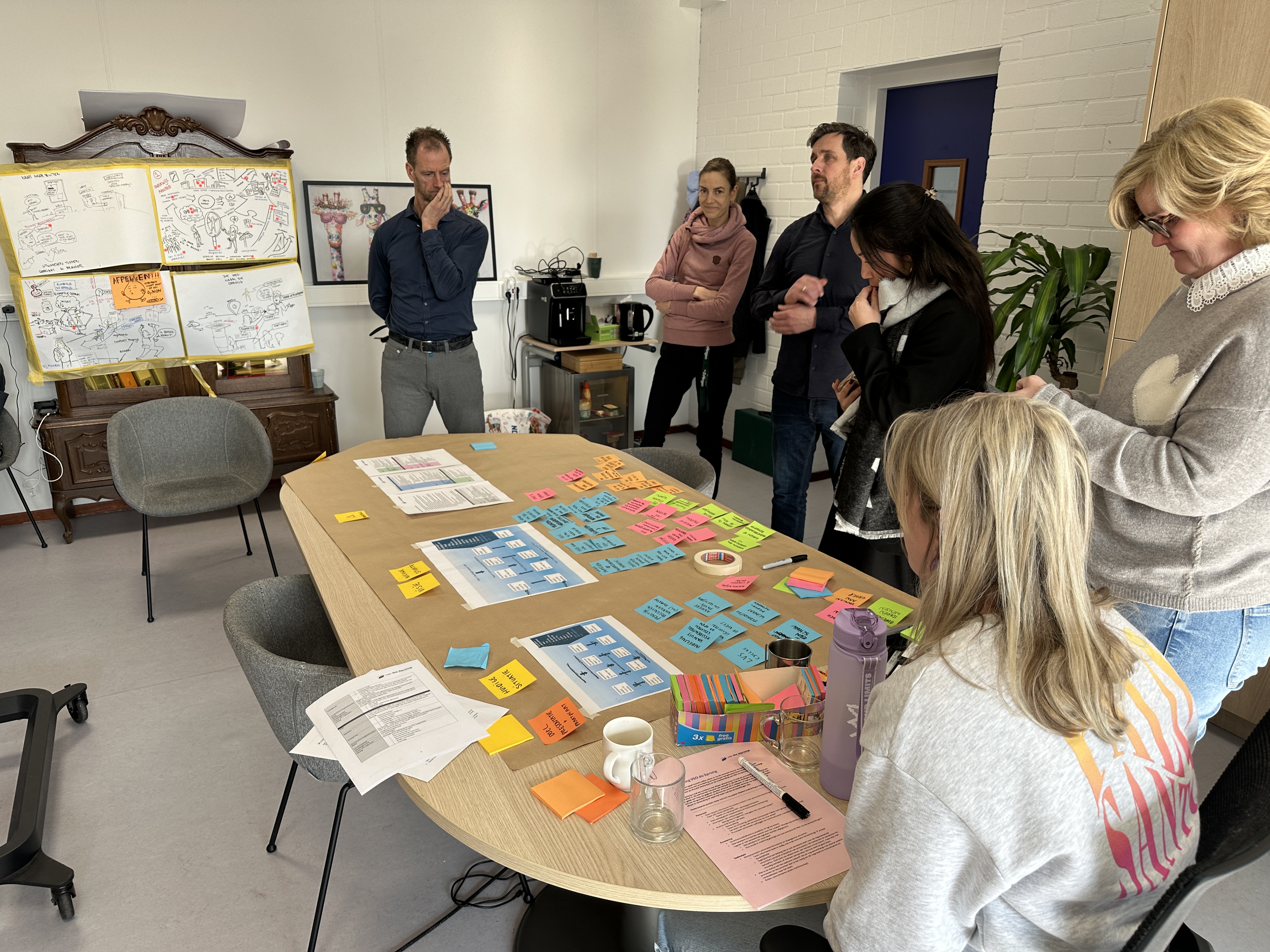
Grouping based on support needs
A growth mindset is the belief that you can develop yourself through effort, learning, and persistence. People with a growth mindset do not see mistakes as failures, but as opportunities to grow.
In early May, the first pilot was launched, in which we no longer speak of two departments, but group students based on their support needs. This offers huge opportunities to really organize the level of closeness and safety according to students’ needs, so that they can learn even more effectively.
“In a special secondary education (VSO) school, growth among students and staff arises when careful alignment, open communication, and guided project support come together.
“In a special secondary education (VSO) school, growth among students and staff arises when careful alignment, open communication, and guided project support come together.”
“That is how we create, together, a safe and stimulating environment for every young person at De Sprong.” – Eline Pothof, VSO De Sprong
Finalizing – the new school guide
In the months leading up to the summer of 2025, we bundled all insights and developments. The plans that show what kind of school VSO De Sprong wants to be, which students fit this profile, and how the educational provision is shaped, were brought together in the annual update of the school guide. Because of this, we used the guide as the starting point to flesh out all necessary components, both internally and externally. Naturally, some elements remain internal and serve the internal organization only.
Based on the shared dream, a new visual identity has now been developed in collaboration with COPPER Design, and the new school guide has also been designed.
Curious? You can view the school guide here.
Are you interested in taking your organisation to the next step?
Contact us!